Don’t forget to pre-order your copies today! [A Court of Splintered Harmony] & [A Court of Forgotten Melody]
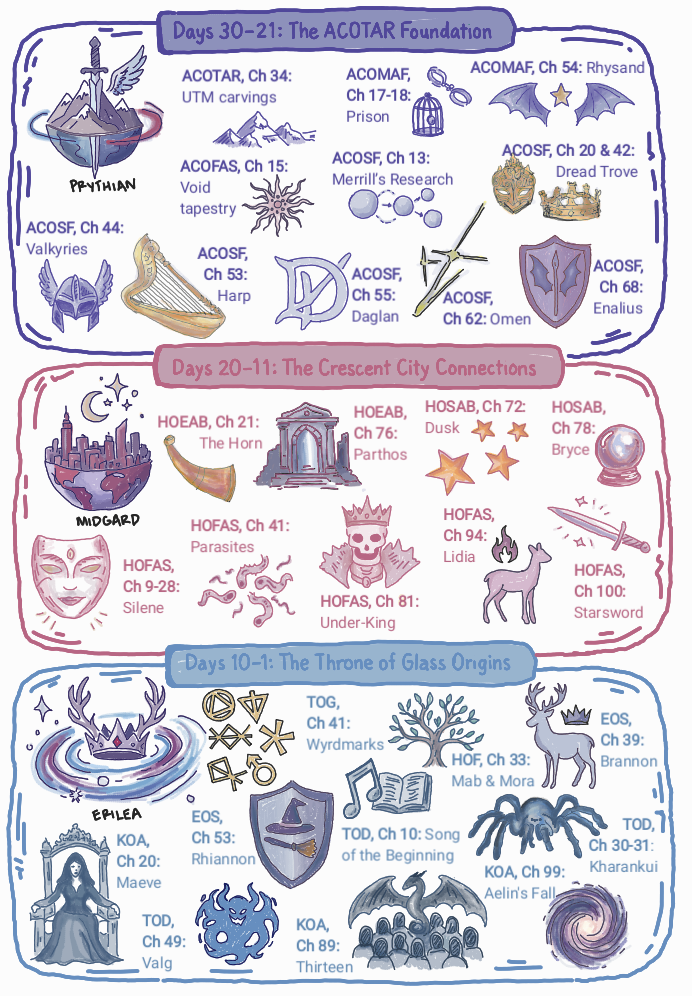
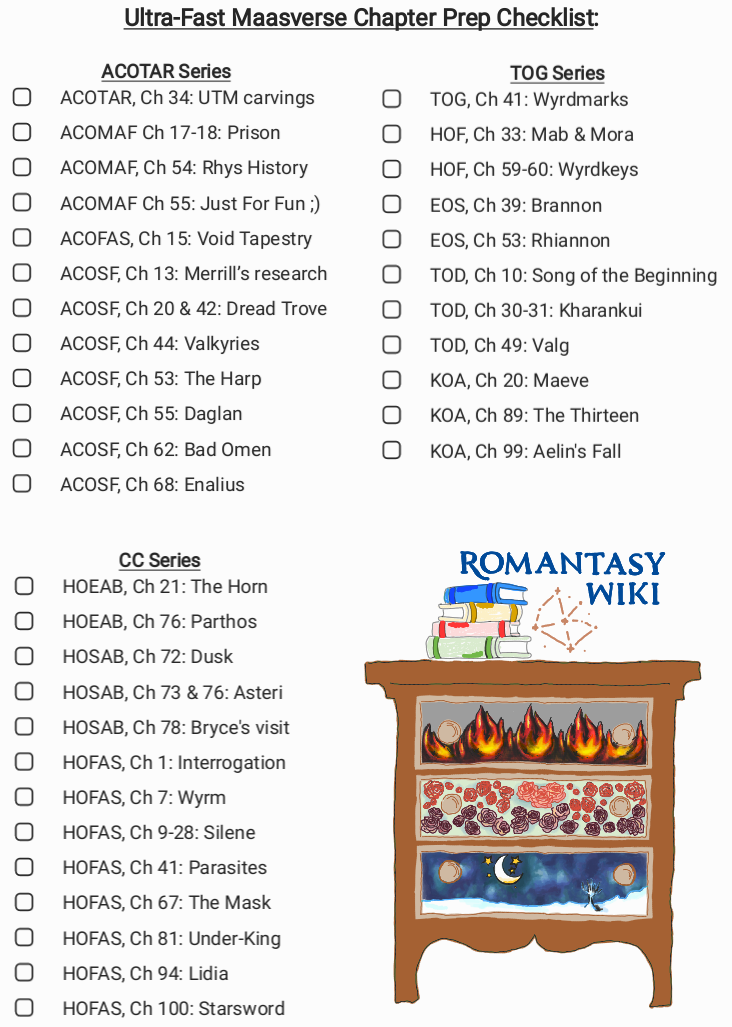
ACOTAR: The Foundation
“That small part of me that had again become trivial and useless noted that the carvings weren’t just ornate designs, but actually depicted faeries and High Fae and animals in various environments and states of movement.”
The Under the Mountain (UTM) carvings mirror the ancient murals and thin-place tunnels found in worlds like Crescent City, serving as a historical record of the universe before it was fractured and hinting at the ancient conflicts with the Daglan. SJM uses setting descriptions to hide clues about interdimensional portals and shared origins of the Fae across her series.
“The Prison is law unto itself; the island may be even an eighth court. But it falls under my jurisdiction, and my blood is keyed to the gates.”
The Prison operates independently as an ancient potential “eighth court” bound exclusively to Rhysand’s bloodline, and crossovers confirm it was originally the legendary Dusk Court. Rhysand’s control over its gates demonstrates his direct lineage to the ancient Starborn bloodline that ruled the island before modern Prythian existed.
“And that Amarantha’s captains held us for weeks, torturing and slaughtering my warriors. They put ash bolts through my wings, and they had those same chains from the other night to keep me down. Those chains are one of Hybern’s greatest assets—stone delved from deep in their land, capable of nullifying a High Fae’s powers. Even mine.”
The Ashwood in ACOTAR is a power-nullifying stone and establishes a universal anti-magic material, perfectly mirroring the Wyrdstone used to enslave magic-users in Throne of Glass and the Asterian Gorsian stone used to subjugate the Vanir in Crescent City. This consistency strongly suggests a shared origin or history of harvesting these minerals to huntthe Fae across different worlds.
“The tapestry had been woven from fabric so black it seemed to devour the light… The insignia, however, had been rendered in silver thread—no, not silver. A sort of iridescent thread that shifted with sparks of color. Like woven starlight. I stared at the black fabric that was like peering into a pit of hell. And then stared at the iridescent, living silver thread that cut through it.”
The light-devouring “Void” fabric directly mirrors the primordial abyss of Hel and its princes from Crescent City, while the iridescent “Hope”
thread matches the visual description of Starborn starlight and Spidersilk from Throne of Glass. Furthermore, the weaver Aranea’s spider-themed name and magical abilities link her directly to the dimension-crossing Stygian Spiders and the Weaver of the Woods.
“Merrill’s brilliant. When she first came here, she was obsessed with theories regarding the existence of different realms—different worlds. Living on top of each other without even knowing it. Whether there is merely one existence, our existence, or if it might be possible for worlds to overlap, occupying the same space but separated by time and a whole bunch of other things.”
This is the first explicit confirmation of the Maasverse, explaining that different worlds physically overlap while occupying the exact same
space. It lays the groundwork for the multidimensional travel seen across the series, directly setting up Bryce Quinlan’s crossover into Prythian in Crescent City and mirroring Aelin Galathynius’s fall through parallel dimensions in Throne of Glass. The reference to “eleven worlds” aligns with the cosmic timeline of the Asteri, who invaded and colonized these exact overlapping realms.
“The Mask can raise the dead. It is a death mask, molded from the face of a long-forgotten king. Wear it and you may summon the dead to you, command them to march at your will. The Crown can influence anyone, even piercing through the mightiest of mental shields. Its only flaw is that it requires close physical proximity to initially sink its claws into a victim’s mind.”
This passage defines the Dread Trove, an ancient triad of artifacts forged by the Cauldron capable of commanding the dead, controlling minds, and tearing open doorways between overlapping dimensions. These relics serve as the primary catalyst for interdimensional travel, directly enabling Bryce Quinlan’s crossover in Crescent City via the Harp, while mirroring the absolute mental and physical subjugation tactics utilized by the cosmic Asteri and Valg.
“I fought beside the Valkyries for five battles. But that stopped at the Battle of Meinir Pass.” His smile faded. “When most of them died to save it. The Valkyries knew it was a suicide mission from the start.”
The tragic sacrifice of the Valkyries at Meinir Pass highlights the historic political betrayals within Prythian and explains their extinction. This event aligns with the collapse of the ancient Dusk Court under its “foolish king” (High King Fionn), directly linking to the disappearance of the pegasuses from Prythian while structurally mirroring the emotional sacrifice of the Thirteen in Throne of Glass.
“Nesta studied the carvings in the floor. “I think these are stars,” she breathed. And like a golden sun, the Harp lay at the center of the system. The Harp sat atop a large rendering of an eight-pointed star. Her fingers brushed the icy metal. The Harp hummed against her skin, as if it still held its final note, from the last time it had been used. Nesta had the sensation of falling, tumbling through air and stars and time—”
The physical pairing of the Harp and the eight-pointed star floor carving confirms that the artifact functions as a cosmic navigation system for interdimensional travel. This specific chamber acts as a geographic tether across the Maasverse, mirroring the Starborn crest and constellation maps found in Crescent City while evoking the exact sensory feeling of Aelin’s multidimensional fall in Throne of Glass.
“The Fae were not the first masters of this world. According to our oldest legends, most now forgotten, we were created by beings who were near-gods—and monsters. The Daglan. They ruled for millennia, and enslaved us and the humans. They were petty and cruel and drank the magic of the land like wine.”
This quote reveals that the Fae were originally subjugated by the Daglan, an ancient master race that parasitically consumed the land’s magic. This confirms that the Daglan are the cosmic Asteri from Crescent City who harvested the power of magical beings across realms. It directly sets up the lore behind High King Fionn’s rebellion, explaining how the Starborn Fae originally defeated these entities before fleeing to Midgard.
“The mood hadn’t been helped by a rare red star blasting across the sky one day—an ill omen, Nesta had heard the priestesses muttering. Cassian reported that even Rhys had been rattled by it, seeming unusually contemplative afterward.”
This star is actually Aelin Galathynius falling through parallel dimensions at the climax of Kingdom of Ash, serving as the ultimate structural timeline bridge between Throne of Glass and A Court of Thorns and Roses. Rhysand’s personal distress stems from this exact cosmic encounter, as he secretly uses his own raw starlight magic to slow her momentum and save her life during her infinite interdimensional drop.
“But a young Illyrian warrior named Enalius held the line against the enemy soldiers for days. He found a natural archway of stone amongst the tangle of boulders and made that his bottleneck. He died in the end, but he held off the enemy long enough for our allies to reach us. This Rite is all to honor him.”
This specific mountain archway is heavily theorized to be an inactive gateway, mirroring the Wyrdgates of Throne of Glass and the portal infrastructure used by the cosmic Asteri in Crescent City. This connection implies Enalius’s ancient final stand was fought to defend a critical interdimensional threshold during the historic rebellion against the Daglan master race.
Crescent City: The Connections
“Luna’s Horn was a weapon wielded by Pelias, the first Starborn Prince, during the First Wars. The Fae forged it in their home world, named it for the goddess in their new one, and used it to battle the demon hordes once they made the Crossing. The Star-Eater himself bred a new horror just to hunt the Horn, using some blood he managed to spill from Prince Pelias on a battlefield and his own terrible essence.”
Luna’s Horn is an ancient Prythian artifact brought to Midgard and Apollion (the Star-Eater), a Prince of Hel who created the kristallos demon by blending his dark essence with Prince Pelias’s Starborn blood to hunt it down. The light and dark magic serves as foreshadowing for Hunt’s true origins and that he was bred using these exact same mechanics, giving him a genetic connection to both Hel and the Starborn Fae that allows him to act as a conduit for Bryce’s powers.
“This is the Great Library of Parthos. Did you know that during the First Wars, when the Asteri gave the order, it was at Parthos that a doomed human army made its final stand against the Vanir? To save proof of what they were before the Rifts opened—to save the books. A hundred thousand humans marched that day knowing they would die.”
This library serves as the ultimate repository for cross-realm artifacts, preserving ancient texts smuggled across dimensions before the rifts
closed. Among the rescued volumes are legendary books like the Book of Breathings from A Court of Thorns and Roses and The Walking Dead from Throne of Glass, confirming that ancient human historians were deeply interconnected with world-walkers from other realities.
“The Asteri had lured them all into this world from other planets. Somehow, using the Northern and Southern Rifts, or whatever way they traveled between worlds, they’d … drawn them into this place. To farm them. Feed off them. Forever.”
This quote shatters Midgard’s history by revealing that the “Crossing” was actually a trap by the Asteri to farm populations for their power. This explicitly confirms that the Asteri (aka Daglan in Prythian) lured the ancestors of the Starborn Fae directly away from the lost Dusk Court to harvest their power. It sets up the entire narrative of House of Flame and Shadow, as it explains why Bryce must return to the Fae home world to unite the realms against their shared cosmic parasites.
“The male stepped forward, tucking in his wings. He smiled slightly and said in the Old Language, in a voice like glorious night, “Hello, Bryce Quinlan. My name is Rhysand.”
Ahh!!! The fandom let out a collective scream. This iconic quote marks the exact moment universes collide, confirming that series exist within a shared multiverse. By having Rhysand welcome Bryce Quinlan in the “Old Language,” it proves that the native tongue of Midgard’s elite Fae is structurally identical to the language of Prythian, cementing their shared history before the rifts were sealed. This crossover bridges the Starborn lineage directly back to the night and starlight magic of the Night Court.
“Yet when my first son was born, when the babe screamed and the sound was full of night, I brought him to the Prison and keyed the wards into his blood. No one knew that the infant who sometimes glowed with starlight had inherited it from me. That it was the light of the evening star. The dusk star.”
You should honestly just read all of chapters 9 thru 28 in HOFAS, because I could pick a million quotes from this section. I picked this one due to Rhysand’s linkage to the Dusk Court and hidden Starborn lineage to Silene. It explains why Rhysand’s blood is keyed to the Prison, and the ancestral bridge across realms, making Rhysand, Ruhn, and Bryce distant cousins.
“The Asteri put an actual parasite in the water—or something like a parasite. It makes everyone on Midgard have to offer up firstlight via the Drop. Or else we’ll lose our powers—we’ll wither and die.”
The “Drop” is not natural, but artificially forced upon Midgard’s citizens by a waterborne parasite engineered by the Asteri. This unmasks the mechanism behind how the Asteri harvest Firstlight to feed on magical energy. It explains why Midgard’s Fae must drop to “anchor” their immortality, while the Fae of Prythian (ACOTAR) and Erilea (Throne of Glass) transition into their magic naturally because their water systems remain uncorrupted.
“I crept through when they charged so blindly into Midgard. This place is much better suited to my needs than the caves and barrows I was confined to. Urd, they call her here—a bastardized version of her true name. Wyrd, we called her in that old world.”
The Under-King reveals his escape from his home world, while exposing that Midgard’s worshipped deity, Urd, is actually a linguistic corruption.
His mention of “caves and barrows” identifies him as a Barrow Wight from the Throne of Glass universe, and his correction of Urd’s name links directly to Wyrd. This establishes a bridge between the realms of Midgard and Erilea.
“It confirmed what Lidia had long guessed. Why she had named Brannon after the oldest legends from her family’s bloodline: of a Fae King from another world, fire in his veins, who had created stags with the power of flame to be his sacred guards.”
This quote marks the moment Lidia Cervos unleashes her flame magic, confirming her lineage as a direct descendant of Brannon from the Throne of Glass universe. Her ability to shift into a stag and wield fire reveals that her ancestors brought the genetics of Terrasen across the dimensional rifts into Midgard. By naming her son Brannon after these ancient family legends, Lidia reveals her potential familial connections to Aelin Galathynius.
“So I want you to take the Starsword.” Bryce held the blade between them. “Gwydion—whatever you call it here. The age of the Starborn is over on Midgard. It ends with me… I think that eight-pointed star was tattooed on you for a reason. Take that sword and go figure out why.”
This marks the end of the Starborn monarchy on Midgard as Bryce passes the legendary Starsword (Gwydion) to Nesta. This exchange returns the weapon of ancient High King Fionn to its Prythian home after fifteen thousand years of cosmic exile. By linking the blade to the eight-pointed star tattoo on Nesta, this moment acts as the ultimate catalyst for future ACOTAR books, strongly positioning Nesta to uncover the lost magic of the Dusk Court.
Throne of Glass: The Origins
“The Wyrdgates. She pressed the heels of her palms into her eyes. Someone was actually using the Wyrdmarks to open a portal to summon this creature. It was impossible, because magic was gone, but the texts said Wyrdmarks existed outside of magic.”
Wyrdmarks are forgotten historical symbols that are a dangerous magic system capable of tearing open reality. These Wyrdgates establish the interdimensional doors that govern the entire multiverse. This single realization sets the foundation for the entire crossover, mirroring the Rifts manipulated by the Asteri in Crescent City and the dimensions bridged by the Harp in A Court of Thorns and Roses.
“But they were all of them ruled by Maeve and her two sisters, whom they called Mora and Mab. Cunning Mora, who bore the shape of a great hawk”—that was Rowan’s mighty bloodline—“Fair Mab, who bore the shape of a swan. And the dark Maeve, whose wildness could not be contained by any single form.”
This quote establishes the bloodlines, linking Rowan to the hawk-shifting Mora and Aelin to the swan-shifting Mab. This legendary sisterhood is later exposed as an intricate illusion woven by the Valg Queen Maeve, who slipped through a Wyrdgate and altered the minds of Mab and Mora to insert herself into their royal lineage. This deception establishes the overarching theme of interdimensional invaders rewriting native history to manipulate and harvest the power of the Fae.
“Aelin withdrew the mangled Eye of Elena from her pack, chucked it once in the air, and jerked her chin at the King of Adarlan. “I think it’s time you met your ancestor.”
Aelin unveils the shared royal ancestry of Terrasen and Adarlan, revealing that she and Dorian both carry the divine, fire-wielding bloodline of Brannon. This ancestry serves as the foundation for the Crescent City series, where the stag-shifting spy Lidia Cervos (Agent Daybright) inherits this same flame magic and names her own son Brannon. This cements Brannon’s lineage as cross-realm royalty of both Erilea and Midgard’s fire-bearing Fae.
“Rhiannon Crochan held the gates to her city for three days and three nights against the three Ironteeth Matrons. Her sisters were dead around her, her children slaughtered, her consort spiked to one of the Ironteeth war caravans. The last Crochan Queen, the final hope of their thousand-year dynasty. And as she lay dying on that killing field, . . . she cursed us.”
The horrific history of the Witch Wars details the fall of the final Crochan Queen and the birth of the bloodline feud of the Witch Kingdom. Rhiannon’s final stand—holding a gate for three days before falling at dawn —perfectly matches the mythology of the Illyrian warrior Enalius on Ramiel. This striking parallel fuels theories that ancient history was rewritten or that Rhiannon’s curse involving the rotting of the land shares an origin with the Asteri’s parasitic magic.
“The Song of Beginning. A history book. The illustration revealed a barren crag, an army of soldiers in dark armor kneeling before it. As if someone had built the gateway of black stone out of thin air. Only swirling black nothing. Beams of it shot from the void, falling upon the soldiers kneeling before it. She ran a finger over the caption below and translated: Orcus. Mantyx. Erawan. Three Valg Kings. Wielders of the Keys.
This description sounds identical to Mount Ramiel in the Night Court, indicating its black onyx monolith is a dormant Wyrdgate used by the
Valg to worldwalk into Prythian. The chilling implication is that an ancient Valg King may be entombed beneath the mountain, explaining why the peak actively feeds on modern Blood Rite warriors. Furthermore, the overlapping lore suggests a historical connection between Valg and ancient Fae, providing an explanation for the shadow magic, beast forms, and Daemati abilities unique to the Night Court.
“A rip appeared in the world. In these very mountains. It opened and closed swiftly, no more than a flash of lightning. But that was all that was needed. For the horrors to enter. The kharankui, and other beasts of shadow. The kharankui—the stygian spiders . . . and other infiltrators. None of them ordinary beasts at all. But Valg.”
The Kharankui spiders are revealed as shadow-weaving Valg and former maidens of Maeve that entered Erilea through a portal who chose to remain behind as guardians of the gateway. This connection bridges the Stygian Spiders of Throne of Glass to Aranea’s light-devouring Void loom and the Weaver of the Woods in A Court of Thorns and Roses, confirming they share a thread-based magic.
“Long ago, there existed a land of dark, and cold, and wind. Ruled by three kings, masters of shadow and pain. Until a queen appeared—her power a new, dark song in the world…Yes, the fire-king. He saw the darkness in her but did not recognize it. But while he did not guess correctly about our queen’s origins, he still knew that his fire . . . She greatly feared his fire. As all true Valg do.”
Maeve is revealed as an interdimensional Valg Queen whose raw power is manifested as “dark song” and fears the fire magic of King Brannon. Her musical power reference directly sets up the upcoming ACOSH book while confirming that Wyrdgates and the Dread Trove Harp are navigated using music. Furthermore, her weakness to flame establishes the cross-realm genetics for why direct descendants—like Aelin and Lidia—wield the exact magic required to destroy these parasites.
“Do you know the story of the queen who walked through worlds?” Seated on the mossy carpet of an ancient glen, one hand toying with the small white flowers strewn across it, Aelin shook her head.
Maeve constructs a glen dreamscape mirroring the lush, floral aesthetic of the Spring Court to lower Aelin’s psychological defenses during her brutal interrogation. This tactical setting demonstrates how she can manipulate minds. This striking parallel seamlessly links the horrific mind-altering magic of Valg with the advanced glamour and Daemati abilities utilized by the High Fae of A Court of Thorns and Roses.
“And it was not darkness, but light— light, bright and pure as the sun on snow, that erupted from Asterin. As the Thirteen, their broken bodies scattered around the tower in a near-circle, made the Yielding as well. Light. They all burned with it. Radiated it. As she and the Thirteen Yielded completely, and blew themselves and the witch tower to smithereens.”
The Thirteen’s final sacrifice beautifully transforms their physical life forces into pure, blinding light to destroy the Valg tower and save Manon. This explosive eruption of radiant soul-magic mirrors the raw, un-siphoned release of Firstlight seen in Crescent City. Their collective energy proves that intense, pure light is the ultimate weapon capable of vaporizing the primordial “Void” utilized by Valg and Asteri parasites.
“The Wyrdgate sealed behind her, and yet she was not home. As it closed, all worlds overlapped. And she now fell through them. One after another after another. Worlds of water, worlds of ice, worlds of darkness. She slammed through them, faster than a shooting star, faster than light. Home. She had to find home—”
The literal collision of worlds as Aelin Galathynius falls through Prythian’s dimension, where Rhysand uses his starlight magic to slow her momentum and save her life. This interaction matches the “rare red star” omen that leaves Rhysand deeply rattled in Chapter 62 of A Court of Silver Flames, firmly binding the physics of their universes. Furthermore, the mention of Feyre being heavily pregnant confirms that the final battles of Throne of Glass run completely simultaneous to the events of ACOSF.